

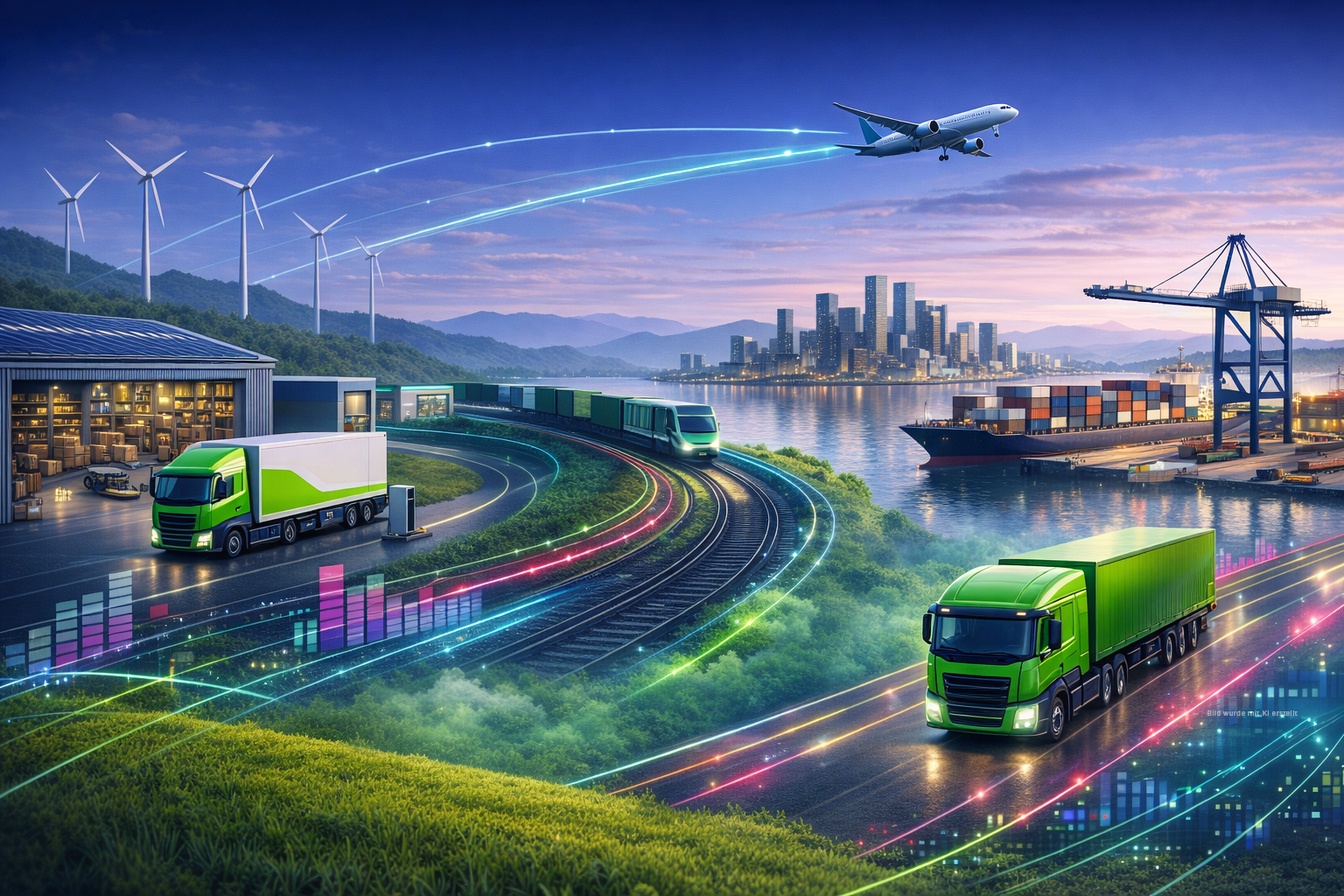
Green Logistics: Sustainability as a competitive advantage
Sustainability in logistics – from a necessity to a strategic opportunity
Sustainability is no longer merely a voluntary commitment. Increasing regulatory requirements, rising expectations from major clients and growing cost pressures mean that Green Logistics a key factor for success in logistics.
But sustainable logistics is about more than just using alternative powertrains. The real key lies in transparent data, intelligent processes and end-to-end digital planning..
What does green logistics mean today?
Green Logistics describes a holistic approach to logistics processes more environmentally friendly, more efficient and more transparent to design – without compromising on service quality or cost-effectiveness.
These include, amongst others:
- the recording and analysis of CO₂ emissions
- the optimisation of transport and route planning
- the reduction of empty runs and unnecessary detours
- data-driven decisions throughout the entire supply chain
Sustainability is not achieved through individual measures, but through systematic process optimisation.
Why sustainability is becoming a competitive advantage
For logistics service providers and major clients, sustainability is now a key differentiating factor:
- Regulatory requirements (e.g. CO₂ reporting, CSRD) are constantly increasing
- Industrial and corporate clients call for transparent emissions data
- Cost and efficiency pressures requires smarter planning rather than extra effort
Companies that are aware of their emissions and can actively manage them benefit in several ways:
- lower costs through optimised transport
- greater transparency for customers
- a stronger positioning as a forward-looking logistics partner
CO₂ Tracking & Route Optimisation: Sustainability starts with data
Without reliable data, sustainability remains a mere assumption. With lbase it becomes a reliable basis for decision-making.
CO₂ tracking with lbase
lbase enables the systematic recording and analysis of CO₂ emissions throughout the transport processes. This is how companies benefit:
- Transparency regarding emission sources
- reliable metrics for customers and reports
- a solid basis for optimisation measures
Optimised routes for lower emissions
lbase supports this through intelligent scheduling and route planning:
- to reduce empty runs
- Making routes more efficient
- Reducing emissions and costs at the same time
CO₂ offsetting to offset unavoidable emissions
Where emissions cannot be completely avoided despite optimisation, lbase supplements the process with CO₂ offsetting:
- Offsetting based on actual emissions data
- Inclusion of certified climate protection projects
- Tangible contributions to sustainability reports and customer communications
The result: sustainable processes with measurable results.
Achieving sustainable logistics processes with lbase
lbase connects Transport management, data intelligence and process automation in a solution.
In this way, green logistics does not become an additional task, but an integral part of day-to-day planning.
The benefits of lbase:
- Sustainability as integrated process, not as a stand-alone solution
- Transparent decision-making criteria for planning and management
- Increased efficiency alongside reduced emissions
Sustainability pays off – both environmentally and economically
FAQs – Frequently asked questions about Green Logistics & lbase
1. What is green logistics?
Green logistics encompasses measures to reduce environmental impact throughout logistics processes – in particular through more efficient planning, lower emissions and transparent data.
2. Why is CO₂ tracking so important in logistics?
Only by measuring emissions can they be effectively reduced. CO₂ tracking creates transparency and forms the basis for optimisation, reporting and meeting customer requirements.
3. How does lbase support sustainable logistics processes?
lbase enables CO₂ tracking, optimised route planning and data-driven decision-making – all integrated into existing transport management processes.
4. What data do I need to calculate and offset my carbon footprint?
The following criteria are required for the calculation: gross weight of the freight (tonnes, containers (TEU, FEU) or pallets), the freight’s origin and destination, and the mode of transport. To improve calculation accuracy, relevant transport parameters such as vehicle type, fuel type, load factor or emission class can be specified individually. If any details are missing, lbase automatically defaults to proven ETW standard values.
lbase: The foundation for a smart supply chain
Practical digitalisation of logistics means modern, efficient processes.
The focus is on:
- Real-time transparency
- Automated processes
- Centralised management of logistics processes
This creates a smart supply chain that can respond flexibly to changes and remains stable in the long term.
Conclusion: Implementing digitalisation in a structured way
Digital logistics is not a one-off project, but an ongoing process.
With lbase, transport companies gain a solution that enables digitalisation in a gradual, controlled and sustainable manner. Real-time data and automation form the foundation for efficient and future-proof logistics processes.
Is digitalisation also beneficial for medium-sized transport companies?
Yes. In small and medium-sized enterprises in particular, digitalisation lays the foundations for growth, efficiency and stable processes – without the need for additional staff.
What role does real-time data play for IT decision-makers?
Real-time data enables informed decision-making, greater transparency and better control of the entire supply chain.
Author: Karin Saltori, Product Marketing